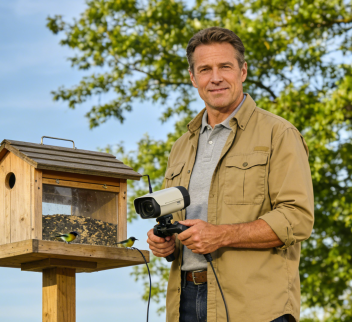
Nothing breaks the immersion of live bird watching like a buffering wheel. You see a bird land, but your screen freezes, and the moment is lost. Achieving smooth, real-time viewing from a bird feeder camera in your backyard isn’t magic—it’s sophisticated engineering. It hinges on two core technologies: optimized Wi-Fi connectivity and efficient streaming protocols. Let’s demystify how these systems work together to deliver the low-latency live streams that make you feel like you’re right there at the feeder.
Table of Contents
The Goal: The “Fast, Accurate, Stable” Data Pipeline
For a Wi-Fi bird feeder camera, low latency means capturing, processing, and transmitting video to your phone with a delay of just 1-3 seconds. This requires a seamless data pipeline that solves three major outdoor challenges: slow transmission, dropouts, and high bandwidth demand.
Tech Deep Dive #1: Optimized Wi-Fi Connectivity
A stable, direct connection is the foundation. Standard Wi-Fi can be unreliable outdoors, but specialized cameras are engineered for it.
1. The Strategic Choice of 2.4GHz
While many devices boast 5GHz, a quality bird feeder camera often prioritizes the 2.4GHz band for outdoor use. Here’s why:
- Superior Range & Penetration: The longer wavelength of 2.4GHz travels farther and better penetrates foliage and minor structural obstructions than 5GHz, providing more consistent coverage across a yard.
- Intelligent Interference Management: Built-in filters and chipsets help the camera distinguish its signal from other household devices (Bluetooth, microwaves, other networks), maintaining a cleaner connection.
- Efficient Direct Connection: Advanced models can establish a more direct data path to your app, minimizing the number of network “hops” and reducing lag.
2. Dynamic Bandwidth Adaptation
Outdoor Wi-Fi strength fluctuates. Smart cameras don’t just push maximum quality; they adapt in real-time.
- Strong Signal: Delivers crisp 2K or 1080p video with minimal delay (~1 second).
- Weaker Signal: Automatically scales down the resolution to maintain a fluid stream, preventing the dreaded freeze-and-buffer cycle. The priority is keeping the live feed live.
Tech Deep Dive #2: Advanced Streaming Technology
With a solid connection, the next step is moving video data efficiently. This is where streaming protocols and hardware encoding come in.
1. Hardware-Accelerated Video Encoding (H.265/HEVC)
The camera doesn’t send raw video; it compresses it first. Using the modern H.265 codec on a dedicated chip is key:
- Efficient Compression: H.265 can cut video file sizes by roughly 50% compared to the older H.264 standard, without sacrificing visible quality. Smaller files transmit faster.
- Dedicated Processing: A separate encoding chip handles this task, freeing the main processor to manage the connection and sensors, which reduces system-level delay.
2. Adaptive Bitrate Streaming (ABR)
This is the genius that keeps your stream smooth. The camera constantly monitors your network’s upload speed.
- Real-Time Adjustment: It dynamically increases or decreases the video’s bitrate (data rate) every fraction of a second.
- The Benefit: If your network hiccups, the stream temporarily uses less data to prevent buffering. When the connection improves, it seamlessly returns to higher quality. You get continuity over perfection.
3. Lightweight Streaming Protocols
Specialized protocols designed for IoT devices minimize transmission overhead. They use smaller data packets and efficient error-correction methods, ensuring more of the bandwidth is used for video data itself, not administrative traffic.
Hardware Synergy: Built to Support the Tech
The software needs capable hardware to execute its job reliably outdoors.
- Quality Image Sensor & Lens: A sharp sensor provides a clean source image for the encoder to work with, improving efficiency.
- Robust Weatherproofing (IP66): A sealed unit protects the sensitive Wi-Fi antenna and internal electronics from rain and dust, which can degrade signal and cause failures.
- Extended Temperature Tolerance: Components rated for wide temperature ranges ensure consistent performance from a cold winter morning to a hot summer afternoon.
Real-World Performance: What to Expect
- Ideal Conditions (Close to router): ~1-2 second delay with HD quality.
- Moderate Conditions (Some distance/obstacles): ~2-3 second delay, with possible automatic resolution adjustment for stability.
- The Bottom Line: You watch action as it happens, not seconds after it’s over. The trade-off for ultimate reliability in weak signal areas might be a slight reduction in resolution, not a frozen screen.
FAQ: Your Low-Latency Questions Answered
- Does low-latency streaming use more data?
- A: No. Efficient encoding (H.265) and adaptive bitrate actually make it more data-efficient than a poorly managed high-bitrate stream.
- Can multiple people watch the live stream without more lag?
- A: Yes, well-designed systems use multicast-like techniques or efficient cloud relays to serve multiple viewers without multiplying the load on your home network.
- What if my Wi-Fi is very weak?
- A: The adaptive bitrate system will lower the video quality to maintain a real-time stream. You’ll still have a live view, just at a lower resolution until the signal improves.
- Does it work offline?
- A: “Live viewing” requires a connection. However, the camera will still record motion events to a local microSD card when offline for you to review later.
Conclusion: Technology for Uninterrupted Wonder
The seamless live stream from your bird feeder camera is a testament to tailored engineering. By optimizing Wi-Fi for range, employing efficient video compression, and adapting to network conditions in real-time, these devices solve the unique challenges of outdoor streaming.
Experience the difference real-time viewing makes. See how a Wi-Fi bird feeder camera with optimized low-latency technology brings your backyard birds to life as it happens.