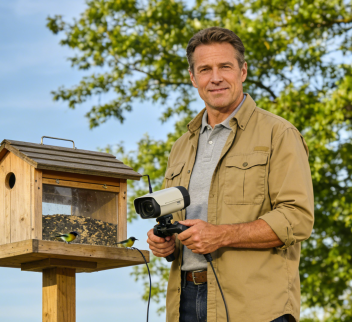
Nighttime bird watching often means grainy, black-and-white footage where an owl’s intricate patterns vanish into a shadowy blur. But modern bird feeder cameras can reveal a hidden world of color, even on moonless nights. This isn’t just bright lighting; it’s a sophisticated combination of intelligent illumination, high-sensitivity hardware, and smart processing. Let’s explore the technology that allows cameras like the Smart Bird Feeder Camera to capture the true hues of nocturnal visitors without disturbing them.
Table of Contents
The Core Challenge: Seeing Color in Near-Total Darkness
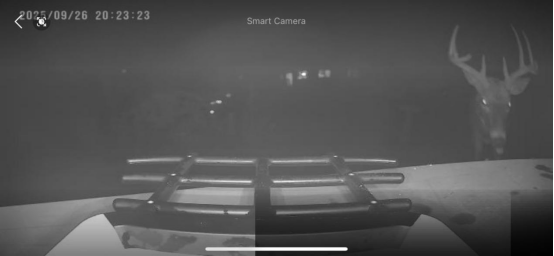
On a moonless night, ambient light can drop below 0.1 lux—essentially pitch black to human eyes. Standard cameras switch to infrared (IR) night vision, producing monochrome images because their sensors can’t gather enough light to distinguish color. True color night vision in a bird feeder camera must solve this by providing usable light for the sensor while accurately reproducing the subject’s natural colors, all without startling wildlife.
The Triple Tech Behind True Color Night Vision
1. Intelligent, Low-Impact Lighting
The goal is to illuminate the scene without creating a visual disturbance.
- Dual-Spectrum Illumination: Advanced cameras use a combination of 850nm near-infrared LEDs (invisible to birds and humans) and very low-level white light. The IR provides a base layer of illumination, while the minimal white light fills in the spectrum needed for color.
- Smart Activation: Paired with motion detection, the lights only activate when an animal is present. This conserves power and minimizes light pollution, ensuring the feeder area isn’t constantly lit.
- Precision Control: The light output is carefully calibrated to cover the feeder zone (typically a 5-8 meter radius) without creating harsh glare or deep shadows that could obscure details.
2. High-Sensitivity Image Sensor
The camera’s “eye” must be exceptionally good at gathering light.
- Larger Pixels: Sensors with larger individual pixels (measured in microns, µm) capture more photons. This greater light-gathering ability is crucial for distinguishing color information in extremely low light.
- Low-Noise Design: A backside-illuminated (BSI) sensor structure and specialized hardware reduce electronic “noise”—the graininess that plagues low-light photos. This results in a cleaner image where colors are more distinct and accurate.
3. Advanced Color Processing Algorithms
Capturing raw light data is only half the battle. The camera’s processor must interpret it correctly.
- Color Calibration & White Balance: Sophisticated algorithms adjust the image in real-time, correcting for the specific color temperature of the camera’s own lights to prevent unnatural tints (like an overall red or blue cast).
- Noise Reduction & Detail Enhancement: Processing cleans up the image while sharpening key details like feather edges and markings, ensuring the color information translates into a usable, clear picture.
- Synergy with AI: Accurate color provides critical data for AI bird identification. Distinctive markings like a raccoon’s mask or an owl’s facial disk become clear identifiers, boosting recognition accuracy compared to monochrome IR footage.
Real-World Performance: What You Can Actually See
In field tests under moonless conditions, this technology enables:
- Identification of Nocturnal Species: Clear enough detail to distinguish between similar species, like different owl types, based on color patterns and size.
- Observation of Natural Behavior: Animals proceed with natural feeding or hunting behaviors, unaffected by the subtle, non-invasive lighting.
- Detailed Imagery: The ability to see the barred patterns on an owl’s feathers or the distinctive coloring of a visiting raccoon, rather than just a silhouette.
Built for the Night: Supporting Features
This advanced vision system is supported by other robust design elements:
- Weatherproof Durability (IP66): Protects the sensitive optics and lighting elements from dew, rain, and dust, ensuring consistent performance in all nighttime conditions.
- Efficient Power Management: Color night vision requires more power than IR. High-capacity batteries paired with efficient solar panel charging ensure the camera can operate through the night without frequent maintenance.
FAQ: Night Vision Color Questions Answered
- Does color night vision use a lot of power?
- A: It uses more than IR mode, but smart activation (lights only on during motion) and efficient components keep consumption manageable. A good solar setup can typically offset the extra drain.
- Will the light scare birds or animals away?
- A: The 850nm IR light is invisible to them. The supplemental white light is very low-level and often not perceived as a threat, especially when it only triggers with movement. Real-world observations show minimal behavioral impact.
- How far does the color night vision work?
- A: Optimal clarity is usually within 5-8 meters (15-25 feet) of the feeder. Beyond that, details may soften, but the camera will often blend modes to maintain a color image.
- Is the color accurate compared to daytime?
- A: It’s very good for identification, though saturation may be slightly lower due to the light levels. The key markings and hues needed to recognize a species are faithfully reproduced.
Conclusion: Illuminating the Nocturnal World
The ability of a bird feeder camera to show true color at night is a remarkable technical achievement. It transforms nighttime monitoring from guessing at shadows to clearly identifying visitors and appreciating their natural beauty. This technology opens up a whole new dimension of backyard wildlife observation, allowing you to discover the vibrant life that thrives after dark.
Ready to see your backyard in a new light? Discover a smart bird feeder camera with advanced color night vision and see who visits when the sun goes down.