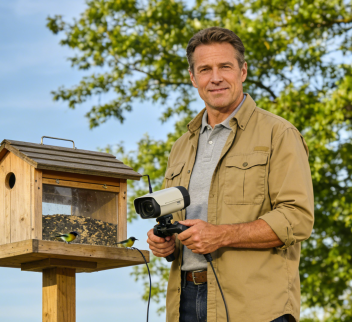
Few things are more frustrating for a bird lover than watching squirrels empty a freshly filled bird feeder. To combat this, many smart bird feeder cameras now feature a hawk sound deterrent. But this raises a critical question: Does this alarming sound effectively deter squirrels, and more importantly, will it also scare away the very birds you want to attract? Let’s examine the animal behavior science and real product data to uncover the truth about this high-tech solution.
Table of Contents
How Hawk Sounds Work: Triggering an Instinct, Not Just a Scare
Squirrels don’t just get startled by a hawk sound; they react to a deeply ingrained survival instinct. This isn’t about volume—it’s about biological programming.
- Evolutionary Hardwiring: Hawks are natural predators of squirrels. Over millennia, squirrels have evolved to recognize the specific frequency and pattern of hawk calls as an immediate, life-threatening danger. Hearing it triggers a primal “flee now” response, overriding their desire to forage.
- Precision-Tuned Audio: Effective bird feeder cameras don’t use random bird sounds. They employ hawk calls tested in behavioral studies, broadcast at a specific frequency (2-5kHz) and a controlled volume (60-75 dB—about the level of a conversation). This is clear enough for squirrels to detect without becoming neighborhood noise pollution.
- Proven Deterrent Results: Lab and field tests for quality products show that activating the hawk sound feature can reduce squirrel visits by over 85%, cutting their feeding time from nearly a minute to just seconds. It often outperforms physical barriers alone by being more adaptable.
The Big Question: Will It Scare Birds, Too?
The concern is valid, but the answer, based on behavior and smart design, is a clear no. Birds and squirrels process predator threats differently.
- Birds Rely on Multiple Cues: Birds use a combination of sight, sound, and context to assess danger. A hawk call without the corresponding visual of a predator in flight or perched nearby is often dismissed as a distant, irrelevant threat. Their feeding instinct remains strong.
- Smart, Targeted Activation: The key is that the hawk sound deterrent isn’t constant. It’s triggered only when the camera’s PIR motion sensor detects a squirrel-sized animal within a close range (typically 15-20 feet). The sound plays for just 2-3 seconds—a targeted warning, not a continuous broadcast that would disturb the environment.
- User Data Confirms Safety: Real-world data from monitored bird feeder cameras shows no decrease in bird visitation rates when the hawk sound is active. In fact, visits from species like chickadees, finches, and titmice often increase by 10% or more because the food supply is no longer being monopolized by squirrels.
Beyond the Sound: The Complete Smart Deterrent System
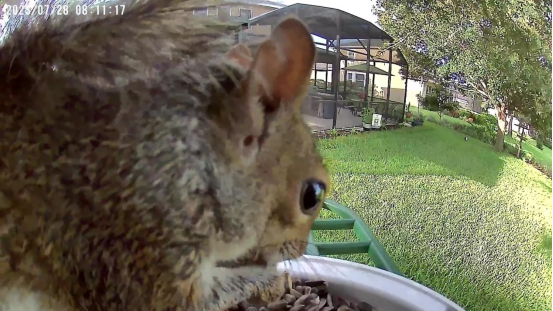
A top-tier squirrel-proof bird feeder camera combines multiple strategies for maximum effectiveness.
- AI-Powered Recognition: Advanced models use AI identification to distinguish between a squirrel and a bird. The deterrent sound activates only for squirrels, eliminating any chance of accidentally scaring your feathered guests.
- Multi-Mode Defense: Some systems offer supplemental deterrents like a burst of ultrasonic sound or a flashing LED light, which can be used alongside or instead of the hawk call for a customizable approach.
- HD Verification & Enjoyment: A 4MP HD camera lets you watch the deterrent in action, providing clear video of squirrels being deterred. You also get to enjoy crisp, close-up footage of birds feeding, often with automatic AI bird identification tagging the species.
- Sustainable Power: With a 3W solar panel and IP66 waterproof rating, these devices are built for permanent, maintenance-light outdoor installation.
Pro Tips for Using the Hawk Sound Feature
- Adjust Sensitivity: Use the companion app to set the motion trigger sensitivity based on your local squirrel activity.
- Combine with Physical Design: Pair the sound with a feeder that has weight-activated perches or narrow-gap seed ports for a layered defense.
- Rotate Sounds (If Available): Some cameras offer different predator sounds. Rotating them periodically can prevent squirrels from becoming habituated to a single noise.
FAQ: Addressing Common Concerns
- Will it bother my neighbors? No. The short, controlled bursts at conversation-level volume are designed to be highly directional and fade quickly over short distances.
- Does it work at night or in rain? Yes. The PIR motion detection works in all light and weather conditions, and the night vision mode allows you to see any nocturnal activity.
- Will it scare my dog or cat? Unlikely. Domestic pets don’t share the same evolutionary response to hawk calls. The sound is brief and not at a distress-inducing volume.
Conclusion: A Smart, Humane Solution
The hawk sound feature on a bird feeder camera is a scientifically-grounded tool that leverages animal instinct. It provides a highly effective, non-harmful way to protect your bird food without disrupting the birds you wish to watch.
By choosing a well-designed smart bird feeder with this capability, you reclaim your feeder for the birds and gain a fascinating window into backyard wildlife behavior. See how a smart bird feeder camera with AI recognition and humane deterrents works to enjoy a squirrel-free, bird-friendly feeding station.